So, you replaced your missing teeth with a full or partial denture. Your journey to a healthier smile should be over now… right? Unfortunately, not so much. Even with artificial teeth, your dental hygiene needs are never over. Full and partial dentures require just as much care as natural teeth do. Brushing, flossing, and attending dental visits at Bivona Family Dental are essential steps in your routine dental care. Without taking care of your prosthetics, you risk various oral health issues that may affect your overall health!
If you’ve restored your smile with full or partial dentures, visit Bivona Family Dental to learn how to take care of them properly.
Explaining Full and Partial Dentures
Full or partial dentures are prosthetics that replace missing teeth.
At Bivona Family Dental, we always aim to save your natural teeth. When some teeth are missing, and others are healthy, we use partial dentures to fill the gaps in your smile.
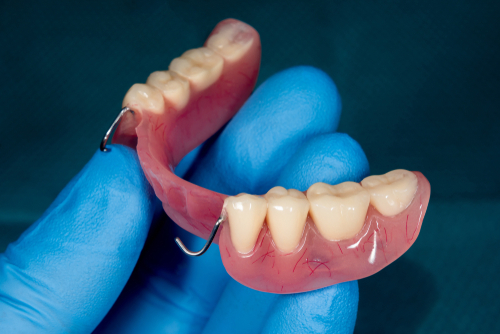 Partial dentures are a continuous prosthetic that typically uses metal or acrylic clips to attach to remaining teeth. Then replacement teeth, called pontics, fill in the empty spaces to restore your smile’s appearance and function.
Full dentures replace your entire arch of teeth, using a gum-colored base that blends naturally with your smile. While lower dentures rely on your bone structure for support, upper dentures use saliva and suction to the roof of your mouth for retention.
Both restorations require care, as your gums and remaining teeth remain at risk for infections such as gum disease and tooth decay.
How To Care for Full and Partial Dentures
Traditional dentures that use your jaw for support require the same care that your natural teeth do. However, these prosthetics need more than just routine dental visits. Caring for full and partial traditional dentures includes:
- Rinsing after meals: After eating, your artificial teeth are typically coated in sugars that harden over time, becoming plaque. If not dealt with promptly, plaque will accumulate bacteria. While your dentures can’t be damaged by infection, your surrounding teeth and gums can be! Rinsing your denture after eating helps ensure that any food particles are removed and nothing is stuck underneath your prosthetic.
- Brushing twice a day: Just like natural teeth, your dentures need to be brushed. If left to accumulate food particles and plaque, your artificial teeth may spread infection and experience staining. At Bivona Family Dental, we recommend using a soft-bristle brush and a non-abrasive denture cleanser. While gently brushing, make sure to clean every surface of your restoration and to remove any denture glue you use for added stability.
- Soaking overnight: After wearing your dentures all day, it’s essential to give your gums a break. The constant pressure of chewing and speaking strains your gum tissue, leading to irritation and denture sores. By removing them at night and soaking them in water or a mild denture cleaning solution to keep them moist, you help protect your gums and dentures from overuse.
- Rinsing in the morning: Upon waking, rinse your dentures before putting them back in your mouth. If you use a cleaning solution to soak them overnight, make sure you remove any traces of chemicals.
By following these denture care instructions, you can keep your smile healthy and happy with a clean restoration.
Caring for Implant Dentures 101
While traditional full and partial dentures are effective, they often lose their fit over time. Loose dentures, typically caused by bone loss in your jaw, create a whole host of issues that affect your daily function. But at Bivona Family Dental, we offer a more secure solution.
Using dental implants, we anchor your prosthetic in place to restore your smile! These dentures are incredibly stable, sitting still while you chew, laugh, and talk without hesitation.
However, caring for implant dentures is a little different than caring for traditional dentures. Depending on the restoration you have, you may not even be able to remove your prosthetic to rinse it.
If you have permanent, non-removable dentures, we recommend treating them like natural teeth. Brush, attend routine dental visits, and floss regularly to keep your gums and implants clean.
Additionally, you can use a special denture floss or a water flosser to get underneath your prosthetic. This extra step keeps your smile healthy for years to come.
Keep Your Smile Healthy With Full and Partial Denture Care
If you’ve replaced missing teeth with a full or partial denture, you still need to maintain regular oral hygiene. In fact, there may be things about caring for dentures that differ significantly from the way you care for natural teeth. Be sure to rinse your denture off, brush it, soak it overnight, and attend routine dental visits to keep your artificial smile healthy.
Book an appointment today at Bivona Family Dental in Jasper, AL, to keep your dentures in good shape.
Follow us on Facebook and Instagram to learn more about the implant denture process.